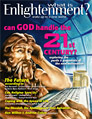
"Some fifty interviews later, our heads are still spinning
with the vision of our future world that has opened up before
us...."
At
What Is Enlightenment? we've always had a deep appreciation
for the great traditions. Indeed, in our ongoing attempt to
bring a critical eye to a postmodern spiritual culture hell-bent
on reducing the quest for truth to a self-improvement program,
we have often leaned heavily on the hard-won wisdom of the
world's religions for inspiration, insight, and plain old
backup. As a result, over the years, our pages have provided a
welcome and much applauded platform for the enlightening words
of many of the most revered traditional teachers of our time. So
when our Spring/Summer 2002 issue, "The Future of God," hit the
stands, we have to admit we were more than a little surprised by
the wave of strong reactions we received from some of our more
traditional spiritual friends. You see, in that issue, in the
inaugural chapter of "The Guru and the Pandit," Andrew Cohen and
Ken Wilber made a proposition that to many traditionalists, it
turns out, was nothing short of blasphemy. They suggested that
enlightenment—the timeless goal of the spiritual
quest—might itself be evolving over time.
Now, in the twenty-first-century West, where the dynamics of
evolution are widely recognized to be at play everywhere—from organisms to organizations, from quarks to galaxies—the possibility that the farther reaches of spiritual
attainment might themselves be evolving along with the rest of
the universe seemed to us a reasonable enough idea to explore.
But as the letters and emails started to pour in, it soon became
clear that although many of our readers found the discussion as
enlightening as we had, in the eyes of some, this line of
inquiry was an indication that we had taken a serious wrong
turn. "To foster the belief that we have discovered or stumbled
upon something that has never occurred in human existence until
now could be . . . dangerous," cautioned one letter. "God is the
same yesterday, today, and tomorrow," exhorted another. One
friend, a Western lama, even wrote me a personal letter to
express his annoyance at the "short shrift" our ponderings on
the evolution of enlightenment gave to traditional Buddhist
ideas. But what really stopped us in our tracks was the barrage
of letters we received from an entire spiritual community—all longtime friends of ours—who had rallied
together to write in protest of our suggestion that something
new could ever emerge on the spiritual horizon. The essence of
their often barbed message: "Put the conversation back where it
belongs: squarely in the human possibility that has always
existed, exists now, and will always exist. . . . There is
nothing new under the sun."
Perhaps we should have seen it coming. After all, it is no
secret that the old resists the new and that tradition, in its
commitment to preserving our connection with what has come
before, must necessarily shield itself to some degree against
the forces of change that threaten its very integrity. But what
was most surprising for us was that the most vehement objections
to our inquiry came not from the barnacled offices of orthodoxy
but from groups and individuals who consider themselves to be at
the leading edge of their traditions—innovators,
pioneers, the avant-garde. If anyone in the traditions was
making room for the possibility of something new, we thought,
surely it would have been them.
Which brings us to the issue you hold in your hands. If you've
paid any attention to the futurists these past few years, then
you, like us, have likely been learning a lot about the
overwhelming insecurities that face all of us as we venture
forth into the new millennium. Like it or not, these cultural
and geopolitical forecasters tell us, we are entering an era in
which sweeping catalytic and possibly cataclysmic forces will
converge in ways that will transform culture, and even life,
into something we can hardly imagine. In this brave new world,
change will be the name of the game, we are told, and our
ability to move with it, adapt to it, and even drive it will be
what determines our individual and collective fate. And herein
lies the rub. For in the face of this volcanic picture—which is looking less and less like science fiction every
day—the rigidity we seemed to have hit up against in
even the most progressive traditionalists raised what for us
seemed to be a crucial question: Are the traditions equipped to
move with the explosive rate of change that the future holds in
store? Is there enough flexibility in these vast repositories of
the world's wisdom to bend to meet an age of transition and
transformation the scale of which the world has never seen? And
if not, what will take their place in providing a moral,
ethical, and spiritual rudder to guide humanity through the
greatest set of challenges we have faced yet? Do we need a new
spirituality? Perhaps even a new religion, more adapted—and more capable of adapting—to the new and
ever-changing life conditions of our time? And if so, what might
such an entity look like? What sorts of structures would the
perennial impulse to manifest a higher order give birth to, once
freed from the myths and mindsets of a bygone age?
Based on our recent experience, we are acutely aware that in
asking questions like these, we run the risk of again taxing the
capacity of our mailbox. So in this issue, which is dedicated
entirely to exploring these pivotal questions, we have gone to
every length we could to make sure we haven't given "short
shrift" to anybody. Which, in practical terms, means we spoke
with almost
everybody—from traditionalists to
futurists, from Zen masters to scientists, from professors to
prophets, from self-styled organizational consultants to
self-proclaimed avatars and messiahs. Some fifty interviews
later, our heads are still spinning with the vision of our
future world that has opened up before us. It's a world as ripe
with promise as it is fraught with peril. And it's a world that,
whatever part tradition plays in it, is going to require a courageous willingness from all of us to leave behind whatever isn't working in order to allow the living creativity of Spirit to help us chart our course through the stormy seas ahead.
–Craig Hamilton





 printer friendly
 email the editors
 advertise
 reprints