There's no doubt that evangelicals are an ever-expanding
demographic in the United States—seventy million and
counting, according to the latest surveys. With this expansion
comes a growing fascination with the end times as promised in
the Bible. Evidence for this fascination can be found in the
statistics surrounding the Left Behind series, the equivalent of
John Grisham suspense novels for the Christian crowd. Written by
Tim LaHaye and Jerry Jenkins, these novels (there are twelve in
all) explore in riveting detail what happens to those people who
are left behind after the Rapture and are forced to suffer
“the great tribulation” of God's wrath. Since the
first book of the series was published in 1995, sixty-two
million copies have been sold, and the video game, children's
book, and comic book offshoots are worth one hundred million
dollars. In the past four years, three movies have been made
based on the books, the first becoming the bestselling video and
DVD in America in 2001–02. Instead of using a distributor
to release the third movie in theaters, authors LaHaye and
Jenkins organized a nationwide screening at 3,100 churches
across the country. Although there are few statistics that
directly connect the popularity of the Left Behind books and
movies with an increase in belief in the Apocalypse, according
to a survey taken by the BBC, fifty-nine percent of all
Americans believe that the events described in the Bible's Book
of Revelation will come to pass.
Considering all this, it's not really any wonder that many
American evangelicals aren't inclined to become
environmentalists. Not only is the environmental movement
generally seen as the realm of secular, nature-worshipping
leftist liberals, but why fight for the survival of the planet
when, as Tim LaHaye has said, “The most significant single
truth in all biblical prophecy is the certainty of the second
coming of Jesus Christ”? The widespread environmental
apathy among evangelicals was perhaps best summed up in the
words of James G. Watt, U.S. Secretary of the Interior under
Ronald Reagan, who said, “My responsibility is to follow
the Scriptures, which call upon us to occupy the land until
Jesus returns.”
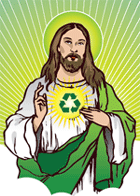
However, this mentality seems to be slowly changing with the
growing popularity of something called
“creation-care,” a movement within the evangelical
community largely spearheaded by Rev. Jim Ball, the executive
director of the Evangelical Environmental Network. In an
evangelical spin on the so-called stewardship ethic advocated by
many Christian environmentalists in the past, Ball believes that
“until Christ returns to reconcile all things, we are
called to be faithful stewards of God's good garden, our earthly
home.” To this end, in 2003, Ball drove his Toyota Prius
from Texas to Washington, DC, asking Christians along the way
what they thought Jesus would drive and encouraging them to
trade in their SUVs for fuel-efficient vehicles. Ball's
foundation is responsible for helping the Endangered Species
Act's renewal, and as result of his work getting evangelicals to
wake up to global concerns like climate change and mercury
poisoning, nearly thirty evangelical leaders representing
forty-five million congregants are banding together with him to
issue a landmark statement on the environment calling
evangelicals to action. In fact, five hundred
evangelical leaders endorsed the Evangelical Environmental
Network's initial guiding statement of faith outlining the
theological and ethical basis for creation-care. Ball, a native
of Texas, has a doctorate in theological ethics, and it was in
graduate school that he began learning about climate change. He
told Rolling Stone magazine last year that
“climate change isn't just an environmental
problem—that's low-balling it. Millions of poor people
could die in this century because of global warming, and
millions of others are at risk of hunger and malnutrition. The
poster child of global warming is a poor child. And Christians
are supposed to look out for the poor, because God loves
them.”
As for those evangelicals who believe the second coming of
Jesus Christ lets them off the hook in caring for the earth,
Rev. Ball says, “With most of these folks, it takes me
about two minutes to punch a huge hole in [the Rapture]
argument.... I also say, 'Well, you take care of your body,
don't you?' It doesn't take that much to win people over.”
Indeed, even Billy Graham, arguably the most notorious
fire-and-brimstone evangelical alive today, recently admitted
that “the growing possibility of our destroying ourselves
and the world with our own neglect and excess is tragic and very
real.”






 printer friendly
 email the editors
 advertise
 reprints