It has been almost four decades since hundreds of thousands of idealistic young Americans went back to the land in one of the greatest mass communal experiments in history. But today, the utopian impulse continues to survive and thrive in ever new forms. In the pages that follow, WIE presents four unique contemporary communities, each inspired by radically different visions, all focused on one thing: the dream of a better world.
The Vistar Foundation
Location: Stamford, Connecticut
Began: 1994
Founders: Ron and Victoria Friedman
Philosophy/Mission Statement: To educate the public about the great spiritual teachings, to provide and promote the Vistar System, to invite and manifest the creative force of collective consciousness in the dramatic arts, and to teach the Vortex Method as a tool for accessing group creative intelligence.
Scattered among the upper-middle-class homes and manicured lawns of suburban Stamford, Connecticut, one of New York City’s more desirable commuter towns, are seventeen individuals who have been meeting regularly in an endeavor that is transforming their lives and opening them to new vistas of consciousness. Following a process that is evolving as they work with it, they are discovering a way of life of meaningful engagement, expanding awareness, and unlimited creativity.
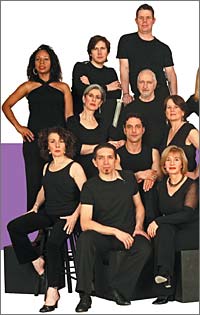
The Vistar Foundation was started by Ron and Victoria Friedman as a means to spread the teachings they’d received from several significant influences in their lives as spiritual seekers. The ideas and example of two teachers, in particular, played a pivotal role in developing the principles on which Vistar is based. One, Charles Ahart, working in upstate New York, elaborated the twelve-step program of Alcoholics Anonymous and combined it with the esoteric work of G.I. Gurdjieff and the anthroposophical ideas of Rudolf Steiner. The other, Kenneth G. Mills, a classically trained musician, multifaceted artist, and exemplar of living elegantly “for the glory of Being,” gave spontaneous philosophical lectures known as “Unfoldments.” The Friedmans also credit nondualistic teachings as a source of their inspiration as well as the ideas and insights of many contemporary spiritual teachers, all of which they readily incorporate into their work.
Originally, the couple’s goals didn’t exceed the intention to give a series of lectures, which was part of their commitment to Ahart, whose only request of those who sought his counsel was to share it with others. Quickly, the lecture series extended to another and then another as attendees wanted more. Soon a core group developed around the Friedmans, many of whom still form part of the Vistar community today, and there are many hundreds of others who have come and gone over the years. Though the Friedmans don’t claim to be spiritual teachers, their guidance and direction are felt in all aspects of the community’s life. There is a hierarchy within the group, they say, and a respect for them as Vistar’s founders. At the same time, one of the group’s unfolding objectives is to explore and model a form of spiritual community without a guru, accomplished master, or unified teaching at its core. In the end, the heart of Vistar is a process, a format for coming together that has become the community’s real teacher.
The Vortex Method of Communication is based on a system initially formulated by Ahart more than twenty-five years ago. It is a discipline for group interaction that grounds and determines all of Vistar’s activities. In the hands of the Friedmans and their colleagues, it has evolved into a finely tuned vehicle for eliciting and sustaining the vigor, mystery, and discrimination of collective intelligence.
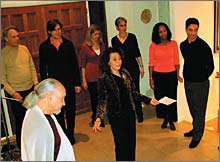
The method is simple yet effective, a means for accessing purpose and developing the contributions of participants into ever-richer and ever-deeper insights and understanding. Its few but strict rules skillfully curb personal interventions and other input that could deflect the direction of the group. Adhered to with consistency and dedication, it has enabled the members of Vistar to transcend personal limitation and to evolve into higher levels of cooperation, creativity, and accord without loss of their individuality. The group members are male and female, multigenerational, and professionally diverse.
The rewards of their focused efforts have been many. Not the least among them is Voicepoint, a unique theatrical ensemble that emerged as a response to the approaching millennium. Inspired by poetry, sacred texts, and quotes from spiritual teachers, Vistar members channel their collective creativity into performances that combine music, voice, and movement to convey the power and beauty of universal spiritual truths. All aspects of these original dramatic presentations are produced through using the group’s techniques for communication and collaboration.
There are other benefits. More and more, the group members are recognizing that they are seeing in new ways, that their perspective on the world and their understanding of the purpose of their work are changing and expanding. It’s more now as if they are in service of the Vortex Method rather than the method being a tool useful to them. “The very process itself,” says Ron, “this incredible guiding force, the collective force field, demands more.” They’ve come to realize that, together, they are accessing deeper, more authentic aspects of themselves, both individually and collectively. And their awareness of the larger implications of their discoveries compels them to proceed while it also bestows on them a dignity and joy that derive only from selfless occupation. They are becoming, as a Vortex session recently evoked, “a receiving apparatus for consciousness at a higher level.”
If Margaret Mead is right about the capacity of a small group of people to effect change, then this dedicated community of individuals—few in number yet focused in purpose—may indeed be a harbinger for what a model of human engagement could be in the future, one in which alignment with a higher purpose is more important than an agreement made through a compromise of lesser values. If nothing else, the arts will be much richer for their efforts. But more importantly, the Vistar community’s success with the Vortex Method holds the promise for a new way of achieving cooperation and discernment among individuals who share a common commitment and goal. It is as if when members of the Vistar Foundation come together in their Vortex circle, a new shape of human consciousness is being born.
Carol Ann Raphael





 printer friendly
 email the editors
 advertise
 reprints