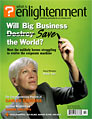
Greg Steltenpohl
“NO MATTER HOW TRANSFORMATIONAL you as an
individual try to be, or are, within a corporate structure,
you're a ship on a sea—a very big sea. And that sea is the
conditions that are built into the system. From my experience at
Odwalla of the transition from company to corporation, I learned
what this really means. No one who has been deeply involved with
large corporations would ever think, even for a second, that
they are just going to stand by and let themselves be evolved
into something else. They have an agenda to consolidate and
concentrate power and wealth. That's what their function is.”
“At Odwalla, we did practically everything we
could—even having a huge number of people aligned with a
positive vision—but we still weren't capable of
controlling the capital structure of the company. The system
itself forces certain outcomes, and I really underestimated
that. There was an incompatibility between the founders' values
and the values of the new investors that came in when we went
public. No matter how carefully you craft your policies, in the
end, if it's a corporation, it's part of the capital system. And
unless you have safeguards built into the structure of your
organization, your company can be taken over and diverted
through a series of processes that are a combination of
intentionality and the momentum of the system itself. Eighteen
months after I left as chairman, Odwalla was sold to Coca-Cola.
And if you look at other examples, like Ben and Jerry's or The
Body Shop or Stonyfield Farms, you'll find that all of them are
now either directly owned and controlled by a big corporation or
well on their way.”
“I'm not trying to deny the importance of transforming
corporations from within. But developing new forms of
cooperation and organization could be an area of incredible
creativity for young people who have a lot of energy to change
things. I've been working with Dee Hock [founder of VISA
International] who has realized that people can come together
and form a constitution that becomes legally binding. These
constitutions are creative documents. As long as you approach
them very carefully and systematically, you can create entities
that are not corporations and yet function with the rights of
corporations but with their own values and principles at the
core.”
“When we started the Interra Project—a new type
of payment card based on a new economics—we asked: What
could be a structure, a way of organizing, that would allow the
values of sustainability and cooperative activity to be built
into whatever we do? What if we formed a membership that
included both businesses and consumers? And what if we
created a movement that could shift the flow of dollars toward
those places in society where they would do the most
good—create the most jobs, cause the least amount of
environmental degradation, and uplift those activities that
people were doing on a citizen and volunteer social basis?”
“The Rudolf Steiner Foundation was the first supporter
of Interra. Steiner talked about 'associative economics.' He
said that unless you could link the consumer, the producer, and
the distributor of the services into the same organization, you
would always have false economics that would pit those different
parties against each other in a win-lose situation. Whereas if
you create marketplaces with structures designed to optimize the
whole—all three parts—then you can do things that
are miraculous, because you can move money around for the
benefit of the whole as opposed to the benefit of only one part.
And that's the Interra principle. It's a payment card that
rewards the purchaser for supporting businesses that have
holistic values and also takes a micro payment off each
transaction to donate to a cause that the purchaser supports. If
we got five million people to spend two hundred dollars a month
inside this economy, then we're talking about tens of billions
of dollars shifting toward sustainable and community-based
economics. Interra can provide a communication and information
infrastructure for the transformative business movement. It's a
little card to change the world. Everybody has to realize that
we have to do nothing less than that. So we're trying to create
an accounting system for it—a motivator, a spark
plug—to get people thinking.”





 printer friendly
 email the editors
 advertise
 reprints