PART I
The Preacher
Santana on intention, motives, and purpose

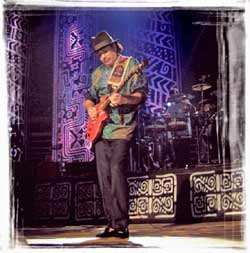
Carlos Santana defies cynicism. A half-million people
watched the electrifying performance at the 1969 Woodstock
Festival that catapulted him to stardom. And since then,
millions upon millions, one generation after another, have been
touched by his music. However, few may realize that Santana's
life is dedicated to keeping alive the utopian ideal of the
sixties: the dream of equality, unity, and love that so many of
us have since abandoned as naïve or nearly impossible to
fulfill. And perhaps even fewer realize that this dream is
inspired by his deeply felt spirituality that transcends race,
culture, and religion. “To live is to dream,” he
said at the 2000 Grammy Awards. And because he continues his
passionate commitment to the dream of human harmony, Santana is
a global ambassador of optimism, opportunity, and love. The goal
of his music—and his life's purpose—far transcends
entertainment. “It's not just to make people happy or make
them dance,” he explains. “It's to change
things—so that we can have a clearer vision of our life
and ourselves, so there won't be so much disharmony in the
world.”
WHAT IS ENLIGHTENMENT: Over the course of
your career, your spiritual beliefs have changed and evolved,
and yet spirituality continues to be the foundation of your
life. You have said that “everyone has divine qualities to
be able to heal and transform. . . . Once you believe, the rest
will follow.” What constitutes the essence of your own
beliefs today?
CARLOS SANTANA: Your intention, motives, and purpose
really define who you are. It's not whether you're Santana or
Smith or Jones, or whether you're Mexican or Hebrew or Catholic
or Buddhist. I don't think God and the angels see any of that
stuff. They just see your intention, your motives, and your
purpose. And once those three are crystallized and sharpened and
are tuned into something, things open up for you—supreme
synchronicity and blessings, opportunities, possibilities.
Everyone is destined to prosperity, to progress, and the keys
that humans need to find are intention, motives, and purpose,
because that is who you really, really are. I'm
surprised they don't teach those three things in school. That's
the gasoline that you need to take you to the next destination,
not all the other stuff. The other stuff is just dust. But for
me, what I'm learning more and more is that those three
things—intention, motives, and purpose—really define
who you are.
WIE: You grew up Catholic, and then at a certain
point became interested in Eastern religion, and then returned
to Christianity. Does Christianity, or any traditional religion,
continue to play a role in your life?
CARLOS: Well, it's indoctrination; that's just what it
is. It's like branding a cow with guilt, shame, judgment,
condemnation, and fear—that's what religion has meant to
me. I get in trouble a lot with the press and with TV because I
say that I don't subscribe to the three P's: politicians, pimps,
and the Pope. I think that all three of them are designed to
sell you fear. And if we are going to move to a new world, we've
got to work with joy—the opposite of guilt,
shame, judgment, condemnation, and fear. There's nothing
spiritual about telling people, “You've got to be like a
Christ. You've got to carry your own cross.” What the hell
is that? Are you telling me that we only come to this world to
suffer? What kind of perverted God would do that? But
nevertheless, a lot of religions have that as their basic
foundation. And people swallow it, believe it, and then you have
a whole bunch of seriously professional victims.
In my life, I don't want to be a victim and I don't want to
be a tragedy. I want triumph—spiritual triumph—with
humility and grace, beauty, elegance, and excellence. You know,
I learned a lot from Duke Ellington about class, and from Nat
King Cole and Gandhi and Martin Luther King, Jr., and John
Coltrane about humility. So I have crystallized all my religion
into no religion—into spirituality. Religion is finely
designed to divide and separate; spirituality brings unity and
forgiveness and compassion.
WIE: Can you elaborate on how spirituality,
in the way that you're describing it, changes or impacts our
fundamental perspective on life?
CARLOS: When you give birth to your own
sense of clarity, that's when you realize that spirituality can
turn people around to the fact that we have choices, that we're
not stuck with our karma. Most people give up, thinking,
“My astrology says this, my karma says that, and my
parents were no good so I'm acting no good.” So people
resign themselves, but it's because they don't realize that in
every breath, you have a choice. Whatever you think, you say,
you do, it creates a momentum.
Spirituality to me is water. Religions are like Pepsi-Cola,
Coca-Cola, wine, beer, or whatever. But spirituality is what's
really going to save you in the battle, man. Champagne is not
going to do much for you in battle. And so that's how I look at
things. To me, it's very clear. And I think the more we get
people this information, spiritual information, they
will be able to choose, to realize the power of choice because,
again, that's the most empowering thing you can give people. And
I'm really happy to say that I'm not the only one waking up to
this new dimension.
WIE: You seem to be suggesting that choice
and free will are really the cornerstones of spiritual life. Can
you say more about that?
CARLOS: When we die, when you die, when I die, we will
get a standing ovation from demons and angels because we did
things that they cannot do, because we have free will.
Angels and demons cannot create a Golden Gate Bridge. We come
out of a woman and are so frail and so weak, yet we dream.
People may tell us, “It could never happen. It will cost
too much money; it will take an army of people; it will take a
long time; it will be tough—concrete and cement and
steel.” But there's the Golden Gate Bridge! Jesus didn't
do that. And after all, he told us, “You would do things
that I cannot do.” That's spiritual.
But most people are not in a place where they can hold their
worth. God made me worth something, but we're not programmed to
think like this. Most people squirm or interrupt you when you
give them a compliment because they think, “I'm not
worthy” or “It will go to my head.” Man, suck
it up; be gracious and say, “Thank you. I'm glad you
enjoyed it.” Because when we wake up to the fullness of
the world, the foundation being spiritual principles, then we
can see what Jesus wanted, or Buddha, Krishna, Allah, Rama,
Jehovah—what they really wanted from us.
WIE: Where do you find your greatest source of
spiritual inspiration?
CARLOS: My meat and potatoes is my intention, motives,
and purpose, and the company that I keep. My phone rings and
it's Mr. Desmond Tutu or Mr. Harry Belafonte. It's okay to brag
because they are the people that I would rather have calling
me—and people like Miles Davis or Wayne Shorter. If I
never got an award, that would be fine with me, because the
company that I keep is very inspiring and stimulating. I love
hanging around vibrant people, people who don't walk around with
a tag. You can never put a tag on a Mandela or a Desmond Tutu or
a Harry Belafonte. You cannot buy these people, and once they
set out to do something, you can't bribe them. Those are the
kinds of people that I'd like to be center stage with.
WIE: You have said of the 1960s that you
“miss those days, the fire and the hunger that people had
and the urgent sense that things had to change.” How do
you experience that urgency now, at the threshold of a new
millennium that's fraught with unprecedented global crisis?
CARLOS: I bring practical spirituality together with
the rebel from the street, because I still live the principles
of the sixties. I'm still a hippie. We were rainbow warriors,
reincarnated Native American Indians who wanted a different
dimension of existence. And it may sound idealistic, but it's
working for me. It's working for me better than the so-called
meat-and-potatoes reality of a lot of people. To me, being
spiritual is not being meek. I don't know anything about turning
the other cheek. I don't believe in violence, but I believe in
taking action. And I guess that's why my wife, Deborah, and I
are so involved with children, because if you change the
children, you can change the world. The older people, they're
already set, but we feel very passionately that if you put new
data and new information out, something miraculous is possible.
I think we have to tell Dunlop, Nike, Starbucks, all the
biggest tobacco and oil companies, all those people: you can
make a difference in the world. You can do something from
your heart that will benefit a lot of people on the planet, and
you'll still be profitable. That's spiritual. And if
you're not doing that, then you're basically retarding the
existence of this planet. I do believe what Thomas Jefferson
used to say—that tyrants are disobedient to God, and we
can't let them continue to destroy this planet, the people, and
the ocean. So obviously, I'd like to change the powers of the
world because they've had their turn. I think it's important to
see a new parade of people who are in a position to change the
consciousness—not just the same creepy old guard.
WIE: You have been quoted as saying that through
your music you “want to connect the molecules with the
light.” Can you explain what you mean by that?
CARLOS: When you hear something
incredible that moves you to dance, to cry and dance at the same
time, your molecules change. To a meat-and-potatoes person, the
first time your molecules change is when you French kiss or when
you play hide-and-seek and you touch someone's hand; something
happens to your body. But how do you put spiritual principles
into practical everyday reality that people can digest? Well,
it's not impossible.
So in conclusion, I'm happy to tell you that we're not alone;
there are a lot of people who are resonating with this and want
the same thing. I think the door is open; we want it now. We
want spiritual revolution, consciousness revolution. That's what
the Beatles and Marvin Gaye and John Lennon and John Coltrane
were talking about. We all want the same thing, and that can be
attained! It's not impossible. And more than anything, I invite
you to crystallize your intention, motives, and purpose, because
if you don't do that, you're always going to blame somebody else
for what you didn't get to do.





 printer friendly
 email the editors
 advertise
 reprints